
Table of Contents (13 sections)
Most dropshippers who plateau at a few thousand dollars a month aren't stuck because they picked the wrong product. They're stuck because every ad they run says roughly the same thing, to roughly the same imaginary customer, and they have no structured way to find out why it isn't converting.
The stores that break past that ceiling tend to do three things differently: they build specific, evidence-based customer personas instead of vague demographics, they test ad angles the way an analyst tests a hypothesis, and they produce far more creative variations than a solo operator could realistically hand-make. What's changed recently is that AI tools have made the second and third of those genuinely achievable without a production team or a media-buying agency. This guide walks through how that actually works: what a real customer avatar looks like, how to test angles without guessing, why Meta's ad delivery now rewards creative variety more than manual targeting, and how offer design still decides more outcomes than the ad itself.
One case example in the source video claims that a dropshipping operator generated approximately $7.97 million in revenue over 11 months while using Claude AI as part of the research and creative workflow. That figure is creator-reported and has not been independently verified, so treat it as context for the method rather than a typical or guaranteed outcome.
Why "Winning Product" Usually Isn't the Real Bottleneck
It's tempting to treat product selection as the single decision that makes or breaks a store. In practice, once a product clears a basic bar (real demand, workable margin, no dealbreaker shipping or return problem), the gap between stores that scale and stores that stall shows up downstream: in the creative, the targeting, and the offer.
A useful way to see this is to look at a competitor selling a near-identical product. A blade-adjustment trimmer sold under a private label, sourced for a few dollars and priced at $50 to $60, isn't winning because the product is unique. Anyone can reverse-image-search the listing on a supplier marketplace and find the same item. It's winning because someone did the unglamorous work of figuring out who actually wants it and why, then said that back to them clearly.
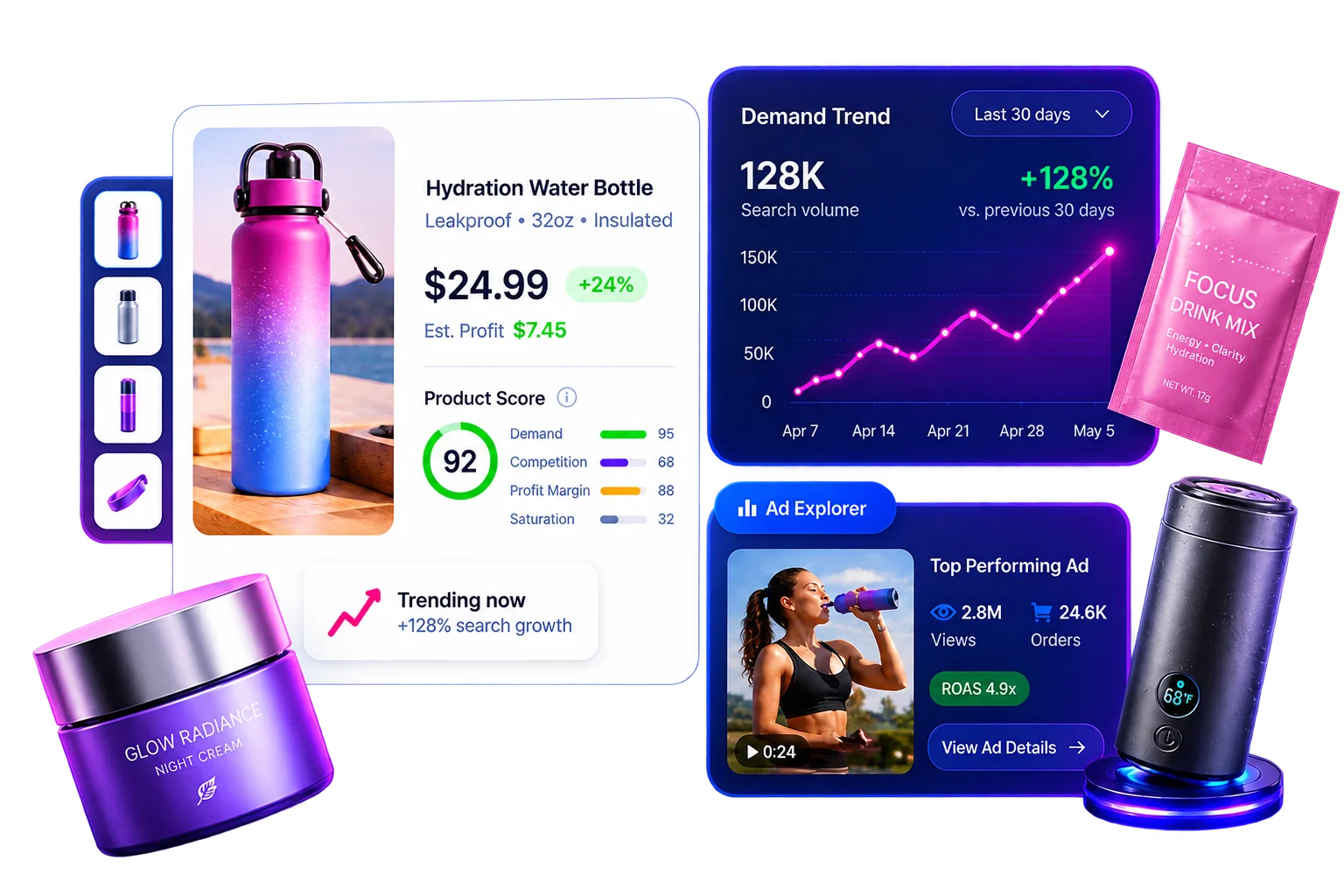
None of this replaces the need to validate a product before you invest weeks into avatar research and creative production. If a product has no real advertising history, a shrinking trend, or margin too thin to survive testing, no amount of angle testing will fix that. That earlier screening step, checking a product's ad activity, lifecycle stage, and data quality before committing budget to it, is exactly what a research tool like Dropmind's Winning Products and its AI Score are built to support. Treat that as the gate you pass through before the work described in this article, not a replacement for it.
What a Real Customer Avatar Actually Is
"Women 25 to 55" is not an avatar. It's a phone book entry. A real avatar is one specific, plausible person: a name, an age, a bad day, and a sentence they would actually say out loud to a friend about the problem your product solves.
The reason this distinction matters is that people don't buy products, they buy relief from a specific frustration, described in their own words. A trimmer buyer who's angry that a previous clipper "cut me" mid-cut is a different avatar from one who's embarrassed about looking rough between barber visits, even though both might fit the same age-and-gender bucket. Same product, different reason to want it, different words, different ad.
A workable process for finding these avatars looks like this:
- Pull language from real evidence. Reviews, comments on competitor ads, and Reddit or forum threads about the product category are full of actual customer phrasing: complaints, praise, and the specific moment something went wrong or worked.
- Draft several candidate personas from that language, not from assumptions about who "should" want the product.
- Pick three to five, deliberately, because different customers buy the same product for different reasons, and testing several angles side by side is how you find out which reason actually converts.
- Go deep on each one. A useful avatar profile answers specific, almost mundane questions: what does their morning routine look like, what would make them abandon your landing page, what convinces them, what nearly stops them from buying.
That last step is where the work gets tedious enough that most sellers skip it, and it's also exactly the kind of task AI is good at accelerating.
Where AI Actually Fits Into Avatar Research
AI tools, including Claude, can process a large volume of reviews and comments quickly, group recurring language into candidate personas, and draft a structured profile for each one: pain points, the exact words customers use for that pain, what nearly stopped them from buying, and what convinced them anyway. Used this way, AI is doing pattern recognition on real evidence, not inventing a customer out of thin air.
The part that should stay manual is the judgment call. A workable version of this process runs in three stages, and the second stage deliberately hands control back to a human:
Stage 1: Generate candidates. Feed the tool real customer language (reviews, comments, complaints) and ask it to draft several plausible personas grounded in that evidence.
Stage 2: Choose, don't automate. A human picks which three to five personas are worth pursuing. This is the step to protect. Letting a model pick your final avatars removes the judgment that actually differentiates a well-researched angle from a generic one.
Stage 3: Deepen and cross-check. For each chosen persona, go deeper with the kind of specific questions above, then check what competitors already say to a similar audience so you know which angles are already crowded and which are open.
This is deliberately a research process, not an automation shortcut. The AI compresses the time it takes to read through hundreds of reviews and comments; it doesn't replace the decision about which persona is actually worth building an ad around.
Reading Competitor Ads Instead of Guessing at Angles
Once you have candidate avatars, the next question is which angle to lead with, and the honest answer is that nobody can reliably guess this in advance, not you, not a seasoned media buyer. The workaround isn't intuition. It's evidence.
A competitor's ad library is a public record of what they're actually still spending money on. Filtering a competitor's ads by reach and total spend, then focusing on the handful that have been running longest and hardest, tells you which messages have survived real budget over real time. An ad that's been live for months, with meaningful spend behind it, is a signal that it's converting well enough to keep funding, not proof, since a large brand can subsidize an underperforming ad for other reasons, but a useful signal worth building on rather than ignoring.
This is a research habit, not a specific tool. You can do it manually inside a platform's own ad library, or use ad-intelligence tooling built for exactly this job, filtering by spend, longevity, and creative format instead of scrolling a competitor's page by eye. Dropmind's Ads Explorer is built around that same idea: surfacing how long a creative has run, how many variations exist, and where the traffic is landing, so you're reacting to evidence instead of a hunch.
What you're looking for in a competitor's longest-running ads isn't a script to copy. It's the underlying mechanism: which pain point they lead with, what claim earns the click, and what objection they preempt. That mechanism, not the exact wording, is what you translate into your own angle, aimed at your own avatar.
The Angle-Testing Framework That Removes the Guessing
An angle is not the product. It's the psychological reason someone should care about it, and it's independent of the product itself. The same trimmer can be sold as a money-saver (skip the barber), a confidence fix (stop looking rough), or a quality complaint (your old clipper wasn't precise enough). Same box, three different reasons to want it, and one of those reasons will usually outperform the other two by a wide margin. The problem is that nobody can predict which one in advance. That's not a creative-skill problem. It's a measurement problem, and it gets solved with a controlled test, not a better guess.
A workable test structure looks like this:
| Test variable | Rule |
|---|---|
| What changes | Only the angle or avatar, nothing else |
| What stays fixed | Same product, same landing page structure, same budget |
| Test window | A fixed, short window (commonly around three days) so results aren't diluted by drift |
| Decision metric | Cost per purchase, and nothing else, during the test window |
| Kill rule | Anything performing roughly twice as bad as the current best angle gets turned off |
The discipline here is emotional as much as procedural. It's easy to get attached to an ad you personally like and keep it running past the point the data says it should die. Detaching from that bias, and letting cost per purchase make the call instead of a gut feeling, is most of what separates a systematic testing operation from a store running the same three ads for six months because nobody wants to admit they aren't working.
One practical extension of this framework: pair each angle with its own landing page instead of one generic page for every ad. If an ad leads with "your old clipper wasn't precise enough," the landing page should open on that same complaint, not a general product pitch. Mismatched ad-to-landing-page messaging is one of the more common, avoidable reasons a promising angle underperforms in testing.
Why Meta's Ad Delivery Now Rewards Creative Variety, Not Just Targeting
Part of why angle testing matters more than it used to comes down to a real shift in how Meta's ad systems work. In December 2024, Meta's engineering team described a new ad-retrieval system called Andromeda, built to evaluate a much larger set of ad candidates per user and weigh the actual content of an ad's creative more heavily in deciding who sees it, not only historical audience and interest data. Meta reported measurable gains in ad relevance and, for advertisers using generative creative tools, in conversions.
The practical implication for a dropshipping store is straightforward: manually narrowing an audience with interest stacking matters less than it used to, because the system increasingly figures out who to show an ad to based on how the ad itself performs and what it actually communicates. That raises the value of having multiple genuinely distinct angles and creatives in the system at once, since the algorithm has more raw material to learn from, and lowers the value of hand-tuning targeting parameters the way sellers did a few years ago.
This doesn't mean targeting is irrelevant or that creative alone guarantees results. It means the single biggest lever most dropshippers have right now is producing enough distinct, avatar-specific creative to give an increasingly creative-driven system something worth optimizing around.
Producing Enough Ad Creative Without a Production Team
Systematic angle testing only works if you can actually produce enough distinct creative to test, and this used to be the real bottleneck. Filming a new UGC-style video for every angle and avatar, at the volume genuine testing requires (often five or more variations per angle), was out of reach for most solo operators.
Two categories of tools have made this more realistic. Stock UGC libraries built specifically for advertisers, such as GridBank, license real, unscripted vertical video from real creators that you can license and reuse as base footage, organized by niche and searchable by product type. Separately, AI video-generation platforms such as Arcads let you pair a script with a synthetic AI presenter that can deliver it on camera, and increasingly offer AI video-generation models that can extend or restyle footage as well. A common pattern is to combine both: real, unscripted footage in the background builds authenticity, while an AI voice or AI avatar delivers the specific script for that angle, all assembled into a finished vertical ad.
Used well, this closes a genuine gap for small teams that can't film new content every week. It also raises a compliance question worth taking seriously rather than treating purely as a creative tactic. In August 2024, the FTC finalized a rule prohibiting reviews and testimonials that misrepresent themselves as coming from a real person, explicitly including AI-generated fake reviews. An ad script written to sound like a genuine customer's unprompted account, delivered by an AI voice designed so the audience won't realize it's synthetic, sits close enough to that line that it deserves a real compliance review rather than an assumption that it's fine because "everyone does it." This is general education, not legal advice; if your creative leans on AI-voiced testimonial-style scripts, it's worth having a qualified advisor confirm your disclosure practices meet current US requirements before scaling spend behind them.
Practically, that means: disclose AI-generated presenters where required, avoid scripting an AI avatar to claim a specific personal experience it never had, and keep the line between "dramatized ad copy" and "fabricated testimonial" clear in how you brief your creative.
Fixing the Offer Usually Beats Fixing the Ad
An underrated lever in this whole process is the offer itself, independent of the ad or the avatar. The same product, wrapped in two different deals, can convert at meaningfully different rates without a single word of the ad copy changing.
A common structure worth understanding: present a one-time purchase price alongside a subscription option, with a higher reference price crossed out next to the subscription so it visually reads as the better deal, even though the one-time price is actually lower. This works because of a well-documented behavioral pattern called the anchoring effect, where an initial reference number (even an artificial one) shapes how a later price feels, and the closely related decoy effect, where adding a third option changes which of the original two choices looks more attractive. A crossed-out "was $99" next to a $52 kit does real psychological work before a shopper reads a single word of copy.
The same principle shows up in "free gift" bundling: several items individually priced and crossed out, then bundled in for free, communicates more perceived value than a single blanket discount, even at an equivalent effective price. None of this requires misleading pricing. It requires being deliberate about how the same real discount is presented.
The reason this matters more than most sellers assume: a landing page doesn't need to be beautifully designed to convert. It needs to clearly carry a strong offer attached to a strong ad. A polished landing page wrapped around a weak, single-price offer will generally underperform an unremarkable page carrying a genuinely well-structured one. If your cost per purchase problem isn't solving itself through better creative, look at the offer before you look at the design.
Where Supplier and Fulfillment Risk Fits Into This
None of the avatar research, angle testing, or creative production above matters if the order behind a winning ad can't actually ship reliably. At meaningful order volume, fulfillment risk (slow shipping, poor refund handling, unreliable supplier communication) becomes its own separate problem, distinct from everything covered above.
This is a genuinely different layer of the business from product or creative research. US-based fulfillment and supplier networks, such as USA Drop, position themselves around faster domestic-style shipping windows and dedicated account support once order volume clears a minimum threshold, according to the company's own published claims. Whatever supplier or fulfillment partner you use, verify shipping-time claims, refund policy, and support responsiveness independently before scaling spend into a product you can't yet fulfill reliably at volume. Dropmind's product research signals can tell you a product is worth testing; they don't verify a specific supplier's fulfillment reliability, and neither does this article.
Common Mistakes Worth Watching For
Testing more than one variable at a time. Changing the angle and the landing page and the audience in the same test makes it impossible to know which change actually moved the number.
Treating one ad's early performance as proof. A short test window with a small budget can produce noisy results. Treat an early winner as a strong lead worth scaling carefully, not a confirmed fact.
Skipping the human validation step in avatar research. Letting AI pick the final avatars, rather than using it to surface candidates for a human to choose from, tends to produce generic personas that don't actually differentiate one angle from another.
Polishing the landing page before fixing the offer. Design work on a weak offer rarely moves the number that matters.
Assuming a long-running competitor ad is definitely profitable. It's a signal worth acting on, not a guarantee. Some ads run for reasons other than pure performance.
A Practical Way to Start This Week
If you're validating this approach on a single product rather than rebuilding your whole process at once, a reasonable starting sequence looks like this: confirm the product itself has real demand and enough margin to survive testing, pull customer language from reviews and competitor ad comments to draft three candidate avatars, choose the strongest two or three yourself, write one distinct angle per avatar, produce at least three to five creative variations per angle, and run all of them under the same budget and the same short test window before deciding anything. Judge only on cost per purchase, kill what underperforms by roughly double the best result, and rebuild the landing page around whichever angle and offer combination actually wins.
Frequently Asked Questions
Is an AI avatar the same thing as an AI-generated video ad?
Not quite. An AI avatar is typically a synthetic on-camera presenter delivering a script. It's often combined with real, licensed background footage rather than generating the entire scene from scratch, which tends to look more authentic than a fully AI-generated video.
How many ad variations should I actually test per angle?
There's no universal number, but five or more distinct executions per angle gives an ad system enough creative material to find what's working, rather than judging an entire angle off a single video that may simply be a weak edit of a good idea.
Does this replace product research?
No. Everything in this guide assumes you're starting from a product that already has reasonable demand, workable margin, and some evidence of market interest. Avatar and angle testing amplify a viable product; they don't rescue a fundamentally weak one.
Do I need real UGC footage if I'm using an AI avatar?
It's not strictly required, but pairing an AI-voiced avatar with real, licensed footage generally reads as more authentic than an entirely synthetic scene, and it reduces (without eliminating) the compliance question around presenting an AI presenter as a genuine customer.
Is a long-running competitor ad guaranteed to be profitable?
No. Ad longevity and spend are useful signals that a creative is performing well enough to keep funding, but they aren't independent proof of profitability, and a well-funded brand can sustain an underperforming ad for reasons unrelated to its actual conversion rate.
The Realistic Takeaway
None of this is a shortcut to guaranteed results, and the revenue figure in the case study behind this guide (approximately $7.97 million over 11 months) is one operator's own reported number, not a typical outcome or something Dropmind has independently verified. What's genuinely different now is that the research and production work behind serious ad testing, building real avatars from real customer language, running a disciplined angle test, and producing enough creative variations to actually learn something, no longer requires a media-buying agency or a production studio. It requires a repeatable process and the discipline to let the data, not your own attachment to a favorite ad, decide what survives. Start with one product you've already validated, build three real avatars from real evidence, and test one variable at a time before you scale anything.