
Table of Contents (12 sections)
A well-known self-made entrepreneur recently put a specific claim to the test in public: that AI can now build a real dropshipping business almost by itself. He gave himself seven days, a $250 budget, and one rule that mattered more than the others: AI had to make every business decision, from the niche down to the ad copy. If he didn't clear $1,000 in profit, he'd hand $1,000 of his own money to a stranger in the comments.
He didn't hit $1,000. He cleared $81.56 in profit on $402.41 of revenue, sold almost all of it through a single product, and one of his three "AI-picked" products turned out to be junk the moment it arrived in the mail. That's not a failure story and it isn't a hype story either. It's a fairly honest look at what AI tooling can and can't do for a dropshipping store right now, and the details matter more than the headline number.
This breakdown pulls apart what actually happened at each stage, verifies the parts that can be independently checked (Shopify's current trial terms, the .store domain claims, the ad-platform shift that makes creative variety matter more than it used to), and points out where "AI made the decision" is doing more marketing work than technical work. The dollar figures below are exactly as reported in the source case study. They're a single, unverified data point from one operator over one week, not a typical or guaranteed outcome.
The Three Rules That Made This a Real Test
Most "AI built me a business" content skips the part where you can check the work. This challenge was structured around three constraints that make it worth examining instead of dismissing:
- AI had to make every business decision. Niche, product picks, brand name, ad angles: all delegated to AI tools rather than the operator's own instinct.
- A $250 total budget, with most of it earmarked for advertising, which forced every tool choice toward free or near-free options.
- Full transparency, including the raw, unedited results rather than a highlight reel.
The budget constraint is the one worth paying attention to if you're planning something similar. $250 does not leave room for a premium theme, a paid supplier directory subscription, and a serious ad budget all at once. Something has to be nearly free, and in this case that was the store-build tooling and the product-sourcing platform, which is a big part of why the results below look the way they do.

Step One: Finding a Niche by Manually Scrolling Ads
The niche-discovery method here was blunt: create a fresh social account, scroll short-form video ads for about an hour, and engage with anything that looked like a real dropshipping product, then feed the resulting list of products into an AI chat tool and ask it to pick a niche. Pets won, based on a decent-looking dog paw cleaner and a handful of other pet accessories that kept showing up in the feed.
This works, and it's also the slowest, least repeatable part of the entire process. An hour of manual scrolling produces a small, subjective sample of whatever the algorithm happens to be showing one account that day. There's no way to see how long those ads have actually been running, whether the advertiser is still spending on them, or whether the products are trending up or fading. A single hour of scrolling can't tell you that.
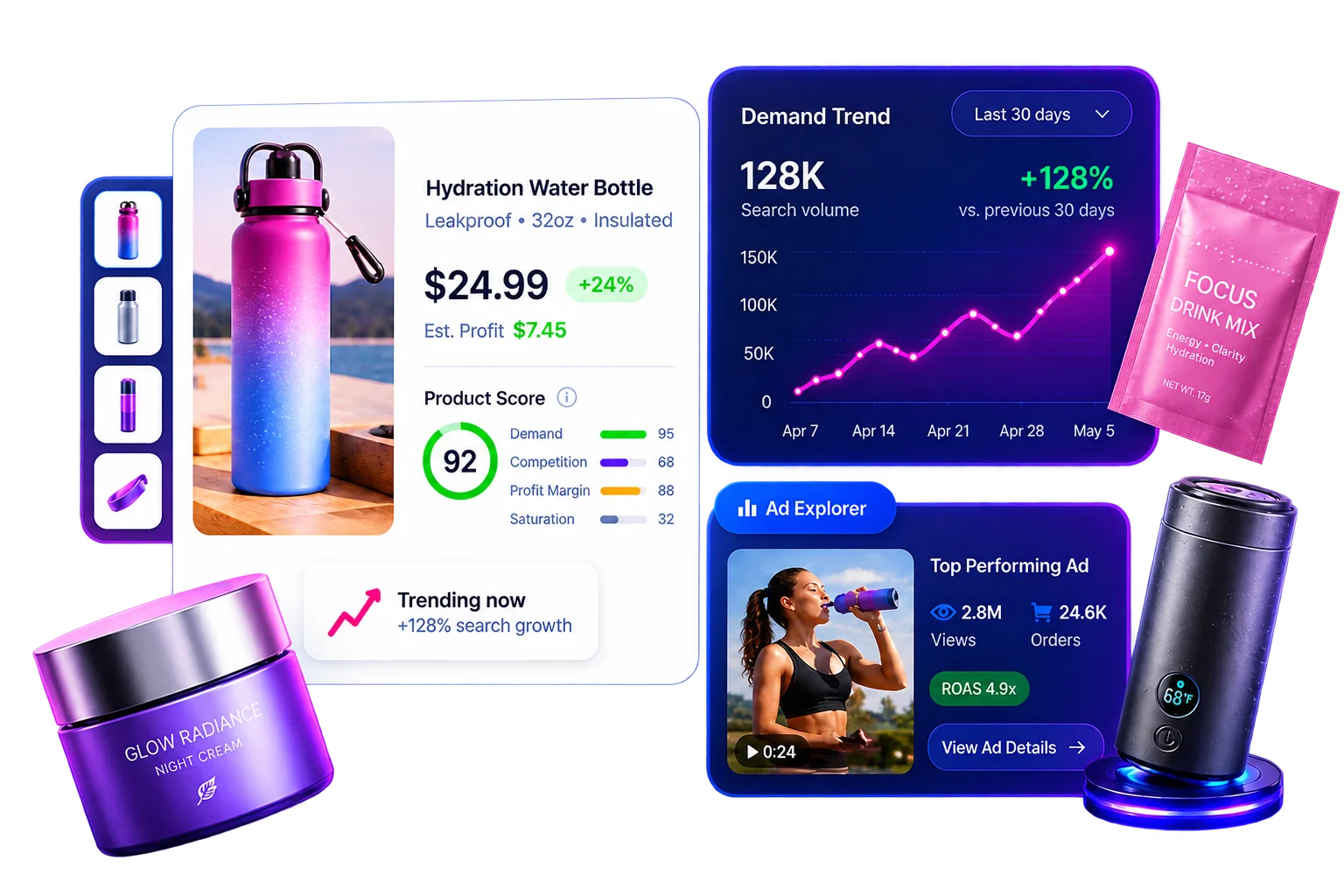
That's the specific gap a product-research tool is built to close, not by replacing the judgment call but by giving it something to work from. Reviewing ad longevity, creative volume, and lifecycle stage inside a tool like Dropmind's Ads Explorer and cross-referencing it against Winning Products' AI Score turns "this looked good in my feed" into "this has been actively advertised for weeks across multiple creatives, which is a signal worth investigating further." It's still a signal, not proof, but it's a far more current and repeatable one than an hour of doomscrolling.
Step Two: Letting AI Build the Actual Storefront
Once pets was locked in, an AI store-setup tool handled the mechanical build: picking two store banners from AI-suggested options, creating the Shopify account, and connecting the two together. This part of the process has genuinely gotten faster. Building a passable Shopify storefront by hand, picking a theme, writing banner copy, setting up navigation, used to eat a weekend for a first-timer. Here it took a fraction of that.
Two of the choices worth verifying independently: Shopify's introductory offer and the store's domain extension.
Shopify's current trial terms are three days free with no card required, followed by $1 a month for the first three months before standard pricing applies, which starts at $39 a month for the Basic plan (or roughly $29 a month billed annually). That matches what was used in the case study, and it's still Shopify's standing offer as of this writing, though promotional terms like this do change without much notice, so confirm the current offer before you sign up.
The store also used a .store domain rather than .com, on the logic that it signals "this is a shop" more clearly than a generic extension. That's a real and reasonably common practice among ecommerce brands and creators: MrBeast's official merchandise storefront runs on mrbeast.store, and .store's own registry lists iShowSpeed and Formula 1 driver Lando Norris among creators and public figures who've adopted the extension for storefronts. It's a legitimate option worth considering, not a requirement. A recognizable .com is still generally easier for customers to remember and trust at first glance, and .store is one reasonable way to signal "store" instantly when the exact .com you want is already taken.
For the store name itself, an AI chat tool generated domain candidates after the first choice was already registered, and a logo came from feeding a text-to-image model, Google's Gemini image model, publicly nicknamed "Nano Banana", a prompt describing the brand. Both steps are realistic, fast, and roughly what you'd expect from current AI tools; neither is where the interesting part of this case study happens.
If you're setting up a Shopify store yourself, whether AI-assisted or not, the mechanical steps (theme, domain, payment setup, and legal pages) are the same regardless of how the niche was chosen. Dropmind's guide to starting a Shopify dropshipping store covers that setup in more depth. You can start a Shopify trial through Shopify to follow along.
Where "AI Picked the Winning Products" Actually Comes From
This is the step worth slowing down on, because "AI selected the products" is doing a lot of marketing work for what's mostly automated catalog import.
The workflow used an AI-assisted dropshipping automation platform, the kind that connects to Shopify, pulls in products from a marketplace feed, sets prices with built-in margin logic, and can push orders to suppliers automatically once a sale comes in. Ten products were added directly from what the platform flagged as "trending," filtered only by category (pets) with no other criteria applied. An AI copywriting feature then rewrote the auto-imported titles and descriptions, several of which had arrived with irrelevant text like a stray "New Year 2026" mention baked into the product name, into something that actually read like professional copy.
That's a legitimate use of AI: cleaning up bad supplier copy at scale is exactly the kind of repetitive task language models are good at. But "trending in this platform's pet category" is a much thinner signal than it sounds. It doesn't tell you how long a specific product has actually been running as an ad, whether multiple advertisers are testing it or just one, or whether the trend is already fading by the time you import it. The platform's own marketplace ranking replaced the judgment step that a genuine product-research process is supposed to provide, and the eventual sales results reflect that gap.
This is also exactly where Dropmind's actual role sits, and where it doesn't. Dropmind doesn't source products, import them into your store, or automate fulfillment. Product-sourcing and automation platforms exist for that, and beyond the one used in this case study, options with an active affiliate or supplier relationship worth researching include Spocket, CJdropshipping, and Wholesale2B, each with different supplier coverage and shipping profiles worth comparing before you commit. What Dropmind is built for is the step before you import anything: checking a specific product's actual ad history, creative volume, and lifecycle stage so "trending in the platform's catalog" becomes "trending, verified against real ad-spend evidence" before it ever reaches your store.
What Happened When the Products Actually Arrived
The most honest part of this entire case study is that three sample products were ordered and physically tested before scaling ad spend, which is a step a lot of dropshippers skip entirely.
| Product | In-hand result | Sales outcome |
|---|---|---|
| Light-up interactive pet toy | Cheap-feeling, malfunctioned during testing | Removed from consideration; zero sales |
| Dog paw cleaner | Solid build quality, clear instructions, worked as advertised | 17 units sold; became the de facto hero product |
| Air-tag dog collar | Good build quality, well received in hand | Zero sales despite being the highest-confidence product |
That middle row and that bottom row are the real lesson. The paw cleaner and the collar were both genuinely good products in hand. Only one of them sold. Product quality didn't predict ad performance at all here, which tracks with something Dropmind's own product research is built around: no single signal (not "AI picked it," not "it feels well made," not "it's trending") is enough on its own. The ad creative, the specific angle, and the audience it reached mattered more than which product was objectively better made.
Ad Creative: AI Avatars Instead of Real UGC
Rather than filming real user-generated content or paying an influencer, an AI-generated UGC avatar tool produced short vertical video ads: a synthetic on-camera presenter reading a script over generated or licensed footage. Three free scripts were generated automatically for the collar; none of them mentioned its actual differentiator (that it holds a tracking tag), so the script was manually rewritten before filming, which is worth noting given that "AI makes every decision" was the challenge's own rule.
Two Meta ad campaigns went live off the back of this, funded from a combined daily budget in the neighborhood of $20. The collar ad never produced a sale and was turned off partway through to preserve budget. The paw cleaner ad is what generated essentially all seventeen sales.
There's a real structural reason AI-generated creative variety matters more on Meta right now than it used to. In December 2024, Meta's engineering team described a new ad-retrieval system called Andromeda, which evaluates a much larger set of ad candidates per user and weighs the actual content of a creative more heavily in delivery decisions, not just historical audience and interest data. Practically, that means the system increasingly figures out who should see an ad based on how the ad itself performs, which raises the value of testing several genuinely distinct angles and lowers the value of manually fine-tuning audience targeting the way sellers did a few years ago.
If you want to go deeper on building and testing AI-assisted ad creative properly, including how to structure angle tests instead of guessing, Dropmind's guide to AI avatar research and ad angle testing covers that process in more detail than this case study did. One caution worth flagging if you go this route: the FTC's Consumer Reviews and Testimonials Rule, finalized in August 2024, prohibits reviews or testimonials that misrepresent themselves as coming from a real person, which includes AI-generated fake testimonials. An AI avatar delivering a scripted ad is generally fine; an AI avatar scripted to claim a specific personal experience it never had is closer to the line the rule addresses. This is general education, not legal advice, so confirm your disclosure practices with a qualified advisor if you're scaling spend behind AI-voiced, testimonial-style scripts.
The Numbers, As Reported
Over seven days, the store generated $402.41 in revenue: 17 units of the dog paw cleaner and one unit of a third product, a "pet magic broom," bought by the same customer in the same order. Costs broke down as follows, exactly as the operator reported them:
| Line item | Amount |
|---|---|
| Product cost and shipping (paid from order revenue, not the starting budget) | $169.85 |
| Meta ad spend over the test period | ~$150 |
| Shopify (after the trial period) | $1 |
| Total cost | $320.85 |
| Net profit | $81.56 |

That profit figure and every line above are exactly as the operator reported them, not independently re-derived. The per-unit product costs mentioned in the source case study don't cleanly multiply out to the stated $169.85 total (likely a simplification or rounding in how the numbers were presented on camera), but the top-line total, cost, and profit figures are internally consistent, so those are the numbers worth trusting from this case study, not the individual per-unit math.
$81.56 in seven days, on a genuinely tested and reasonably built store, is not nothing. It's also nowhere near the $1,000 target the challenge was built around, which is exactly why the operator followed through on giving away $1,000 of his own money rather than claiming a win. Treat the shortfall as the more useful data point here: even with a real product, a functioning store, and paid traffic, a single week rarely produces a stable read on whether a product is genuinely profitable at scale.
What This Case Study Actually Shows About AI and Dropshipping
AI tooling clearly compressed the slow, mechanical parts of starting a store: banner design, copy cleanup, ad-script drafting, and the storefront build itself all happened in a fraction of the time a manual process would take. That part of the claim held up.
What it didn't do was replace product validation. The niche came from an hour of ad-scrolling with no way to check ad longevity or spend. The products came from a marketplace's internal "trending" ranking, not from verified ad-spend evidence. And the eventual result, one working product out of three tested, two of three sample orders producing zero sales despite decent build quality, is a reasonably direct consequence of skipping that step. AI made the execution faster. It didn't make the underlying product picks more reliable, because the tools used for product selection weren't actually doing product research in the way that term implies; they were doing catalog filtering.
That's a useful distinction if you're evaluating any "AI finds winning products" claim, including ones from Dropmind or anyone else: ask specifically what evidence the AI is working from. A tool that filters a supplier catalog by category is a different thing from a tool that evaluates a specific product's actual advertising history, creative volume, and trend direction. Both can be called "AI-powered." Only one of them is closer to genuine research.
Common Mistakes This Case Study Highlights
Treating "AI picked it" as equivalent to "it's validated." An automation platform's trending filter and a genuine product-research signal are not the same evidence, even when both are AI-assisted.
Skipping physical product testing. This case study didn't skip it, and it's exactly what caught a defective product before it reached a single customer. Order a sample before you scale ad spend behind anything.
Assuming build quality predicts ad performance. The best-reviewed product in hand here produced zero sales. The angle and audience mattered more than the product's objective quality.
Testing on one channel with a thin budget and a short window. A week and roughly $150 in ad spend is barely enough to get a directional read on one product, let alone three. Treat an early result as a lead worth investigating further, not a verdict.
Confusing a fast build with a validated business. A store can be assembled correctly and still lose money if the product underneath it was never properly vetted.
A More Reliable Version of This Process
If you want to borrow what worked here and fix what didn't, a reasonable sequence looks like this: use AI to speed up the mechanical build (storefront, banners, copy cleanup) exactly as this case study did, but replace the manual ad-scrolling and marketplace-trending product picks with an actual research pass, checking ad longevity, creative volume, and lifecycle stage before you import anything. Order a physical sample of any product you're seriously considering, the way this case study did. Test more than one ad angle per product instead of one, since Meta's current ad-delivery system rewards creative variety. And give a test more than seven days and more than one traffic channel before you conclude anything about a product's real potential, win or lose.
Frequently Asked Questions
Can AI really build a working dropshipping store on its own?
It can handle the mechanical build, storefront setup, banner design, copy cleanup, and ad-script drafting, quickly and competently. It can't reliably validate whether a specific product is worth selling; that still requires checking real evidence like ad longevity and creative volume, or physically testing the product yourself.
Is the Shopify $1-a-month offer still real?
As of this writing, yes: three days free, then $1 a month for the first three months, based on Shopify's own current pricing page. Promotional offers like this change without much notice, so confirm the current terms before signing up.
Do I need a .store domain instead of .com?
No. It's a legitimate, increasingly common option for signaling "this is a store" when your preferred .com is taken, and some well-known brands and creators use it, but a recognizable .com generally remains easier for customers to trust and remember.
Why did the higher-quality product get zero sales?
Almost certainly the ad angle and audience, not the product itself. This case study didn't test multiple angles for the collar before writing it off, which is a gap worth avoiding: one angle failing doesn't mean the product can't sell.
Is a $250 budget realistic for starting a store this way?
It covered the trial period of every tool and roughly a week of modest ad spend in this case study, but it left almost no room for error. A single failed ad test or a pricier tool subscription would have consumed most of it before any sales came in.
The Realistic Takeaway
This case study is a useful, honestly reported data point rather than a formula to copy exactly. AI genuinely sped up the parts of starting a dropshipping store that used to take a beginner days: the storefront, the branding, the ad creative. It didn't replace the judgment call at the center of the business, which product is actually worth betting on, and the results reflect that gap almost exactly. $81.56 in profit from a real, tested, reasonably built store is a more believable outcome than most dropshipping content on social media, and it's a good baseline for what to expect from speed alone, without a genuine research step underneath it.