
Table of Contents (16 sections)
Most people asking this question have already built the two options into a false choice. Digital products and dropshipping get compared like sports teams, as if one has to lose so the other can win. In practice they solve different problems at different stages of a business, and the operators who do best with either one tend to have used both, just not at the same time.
Here is the direct answer before the reasoning: digital products win on speed, startup cost, and margin, which makes them the better starting point when you have little money and no track record. Dropshipping and other physical-product businesses win on defensibility and long-term equity, which makes them the better foundation once you have some cash flow and want to build something you could eventually sell. AI is changing the math on both, and not in the direction most beginners expect.
The rest of this guide breaks the comparison down across the five areas that actually matter: cost and speed to launch, profit margins, growth ceiling, day-to-day operating reality, and how AI is reshaping each model. Then it lays out a practical sequence for deciding where to start based on where you are right now.
Disclosure: This article includes one affiliate link. We may earn a commission if you sign up through it, at no additional cost to you. This never changes which platforms we cover or how we describe them.
What "digital products" and "dropshipping" actually mean
Digital products are anything a customer downloads or accesses online instead of receiving in a box: online courses, coaching programs, templates, ebooks, paid communities, and PDF guides. There is no physical item, no shipping label, and typically no inventory to manage.
Dropshipping is one specific way of selling physical products: a store lists items it doesn't hold in stock, and when an order comes in, a supplier ships it directly to the customer. It sits inside a broader category of physical-product ecommerce that also includes print-on-demand and branded, custom-manufactured goods. The comparisons below apply most directly to dropshipping and print-on-demand, and partially to branded physical products, which behave differently once a seller owns tooling, formulas, or manufacturing relationships.
Cost and speed to launch
Digital products are close to free to start. A template pack, an ebook, or a PDF guide can cost nothing beyond your own time. If you want a proper website, domain registration and hosting typically run in the range of tens of dollars a year rather than hundreds. There is no inventory to buy, no supplier to vet, and no shipping to coordinate, so it's realistic to go from an idea to a first sale within days.
Dropshipping has a higher and less predictable entry cost. Even with AI tools handling product research and creative production, a realistic starting budget usually includes a recurring cost for software, a Shopify store or similar platform, plus a few hundred dollars set aside for initial ad testing if you aren't relying on organic traffic alone. The timeline is longer too: building a store, sourcing a supplier, and setting up a first test typically takes several days at minimum, and a first profitable product rarely shows up on the first attempt. It's common for a new store to run for weeks, or occasionally longer, before something clicks.
This isn't a knock against dropshipping. It's a structural difference: a digital product is finished the moment you stop working on it, while a physical-product business only starts generating useful data once real orders and real customers are involved.
Why the margins look so different
This is where the two models diverge the most, and it's worth understanding the mechanics rather than just the headline numbers.
A digital product has no cost of goods, no shipping cost, and no supplier taking a cut. The only meaningful expense on a sale is payment processing. Shopify's own published rates for online transactions run from roughly 2.5% to 2.9% plus 30 cents per transaction depending on plan tier, which means a seller keeps close to all of the sale price after fees. If a $47 template sells and payment processing takes a few dollars, the rest is available to keep, covering only the seller's own time and any tools used to build and deliver it. That's a genuinely high-margin business by the standards of almost any other model.
Dropshipping's margin structure is fundamentally different because a physical product has real costs attached to every unit sold: the item itself, shipping, advertising to acquire the customer, and a share lost to returns, refunds, and chargebacks. One experienced operator who has run both models put dropshipping net margins around 25% to 35% after all of those costs, using a $40 product as an example where roughly $10 to $15 ends up kept rather than a much larger share. Treat that as one operator's working estimate rather than an audited industry average; the real number varies by product, niche, and how well a store controls ad spend and return rates, and it can run lower for a store still working out its ad targeting.
There's a middle case worth naming: branded physical products with custom manufacturing, like a private-label supplement or a proprietary formula, can produce better margins than standard dropshipping because the seller owns the product rather than reselling something anyone else can list. Getting there takes real capital and time, though, and it isn't a starting point for someone with no budget and no experience.
If you're optimizing purely for margin per unit sold, digital products win clearly. There's no real competition between a business with close to zero variable cost and one where the product itself, fulfillment, and customer acquisition all take a bite out of every sale.
Growth ceiling and defensibility
Digital products are easy to start and hard to scale past a certain point without changing the business model entirely. One operator who coaches solo digital product sellers has described most of them plateauing somewhere between roughly $5,000 and $15,000 a month, because growth beyond that point usually requires a bigger audience, and audiences take years to build and are finite even then. That range is a working observation from one person's experience, not a measured industry ceiling, but it lines up with a structural reality: courses and coaching can scale well past it, but doing so typically means hiring a sales team, support staff, and content production help, at which point the business no longer runs on the founder's time alone and margins compress toward something closer to a normal services business.
There's also a structural limitation that doesn't show up in the margin numbers: a digital product business built around one person's expertise or personal brand is difficult to sell, because the value is tied to that person continuing to show up.
Physical-product businesses tend to build the opposite kind of asset. A branded product with its own formula, manufacturing relationship, and established customer base is genuinely hard for a competitor to copy. Duplicating it requires developing an equivalent product, finding a comparable manufacturer, and running the same testing and validation work, which takes real time and capital rather than a weekend. That difficulty is what makes a physical-product business more commonly sellable as a standalone asset, independent of who's running it day to day.
The operating reality nobody puts in the pitch
The two models create different kinds of stress, and this part is genuinely a matter of personal fit rather than a universal ranking.
Coaching and course businesses tie revenue directly to how many people you can convince to buy. That incentive structure can pull an operator toward selling to people who probably shouldn't be buying, especially at higher price points, simply because closing the sale is the job. One operator who built a coaching business to roughly $3 million a year in annual revenue has described shutting it down specifically because that incentive structure had started to conflict with how they wanted to run a business. That's one person's account of their own experience, not a claim that every coaching business behaves this way, but the underlying tension it describes, between whether an offer genuinely helps the customer and whether it hits a sales number, is a real dynamic worth watching for in any high-ticket digital offer.
Physical-product businesses carry a different kind of stress that's operational rather than moral: whether a shipment clears customs on time, whether a supplier's quality holds up, whether a fulfillment delay turns into a wave of refund requests. Those are solvable problems with concrete fixes. Which kind of stress you'd rather manage is a genuinely personal call, and it's worth being honest with yourself about before committing to either path.
How AI is changing the calculus for both models
AI has made it dramatically easier to produce a digital product. Anyone can generate a course outline, draft an ebook, or assemble a template pack in an afternoon. That's exactly the problem: the same ease of creation applies to everyone else's competition. A 2026 academic study of self-published genre fiction on Amazon found that as AI-assisted books scaled up, the number of titles with any sales grew roughly 19 times over the study period while total revenue in that category grew only about 9 times, meaning revenue per selling title fell substantially as the market filled with more available content. The researchers concluded that AI is reshaping that market "through scale rather than quality," with AI-assisted titles increasingly competing for the same discoverability regardless of how polished any individual one is.
That dynamic likely generalizes beyond books to any digital product built mainly on formatting and generic instruction rather than the creator's own judgment or direct experience. A digital product built on genuine expertise, original data, or a track record AI can't fabricate still holds real value. A generic template, checklist, or "how to" guide competes in a market where the cost of producing a competitor just dropped to nearly zero.
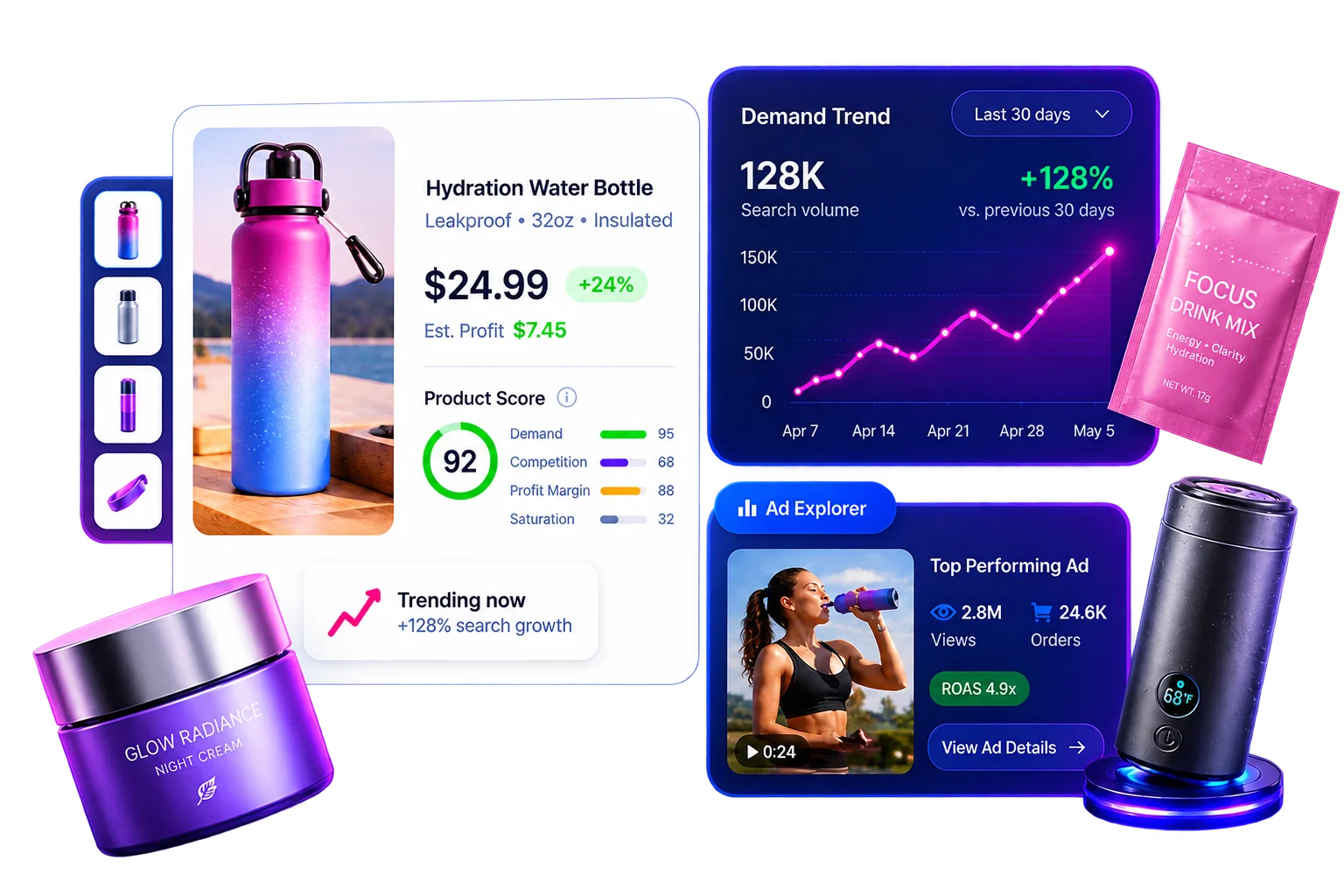
Physical products sit in a very different position. AI makes the research, marketing, and operational side of dropshipping meaningfully faster and cheaper (see Dropmind's realistic AI tool stack for dropshipping for what that looks like in practice), but it can't manufacture a product, physically ship a package, or guarantee that a garment fits the way it's supposed to. That keeps a hard floor under the physical side of the business that AI hasn't touched. The practical effect is more competition at the entry-level testing stage, since AI-assisted research tools lower the barrier for anyone to try, but a genuine moat for sellers who get past testing and build something with a real supplier relationship, tested product quality, and repeat customers. Dropmind's Winning Products and Ads Explorer exist for exactly that earlier, noisier stage: comparing product signals and advertising activity across a market that AI has made more crowded, rather than less, is where structured research earns its keep instead of gut instinct.
Digital products vs. dropshipping at a glance
| Digital products | Dropshipping (physical products) | |
|---|---|---|
| Typical startup cost | Near $0 to roughly $50 for a domain | A few hundred dollars for initial ad testing, plus monthly software costs |
| Time to first sale | Same day to a few days | Typically several days to a few weeks for a first real test |
| Typical margin | Very high; mainly limited by payment processing fees | Commonly cited in the 25% to 35% range after product, shipping, ad spend, and returns |
| Growth ceiling (solo operator) | Often plateaus without hiring a team or building a large audience | Can scale further with the same core operating model |
| Defensibility / moat | Weak once audience-building slows; hard to sell as a standalone asset | Stronger with a branded, tested product and supplier relationship; more commonly sellable |
| Effect of AI | Lowers the barrier to create, increasing competition for generic offers | Lowers the barrier to research and market, but can't replace manufacturing or fulfillment |
| Best starting point | Little to no capital, no track record, need for fast cash flow | Some cash flow or experience already in hand, or building toward a sellable asset |
Which one should you actually start with
There's no single winner here, and being skeptical of anyone who claims otherwise is reasonable. The more useful question is what fits where you're starting from.
If you're starting with close to no money, no experience, and no audience, digital products are the more sensible entry point. The combination of low cost, fast feedback, and high margin means you can learn the fundamentals of selling online, pricing an offer, and handling customers without the operational complexity of sourcing and shipping physical goods.
Once you have some cash flow and more confidence, or if you aren't starting completely from zero, shifting attention toward a physical-product business, most practically through dropshipping while testing, and potentially toward a branded product later, makes sense. Dropmind's step-by-step guide to starting a Shopify dropshipping store covers the setup itself. That's the path that builds a business with real defensibility rather than one tied entirely to your continued personal involvement.
If you're further along, layering digital products back on top of a physical-product business, through content, a community, or educational products built around your own results, can extend the value of an audience you've already earned. That's a materially different situation from starting with digital products alone, because the audience already exists and the content documents a real, ongoing business rather than substituting for one.

Treat this as a sequence rather than a single decision. Each stage can genuinely unlock the next one: digital products for speed and early cash flow, a physical-product business for the harder-to-copy asset, and digital products again, later, to extend the value of what you've built. Skipping straight to the final stage without the groundwork underneath it is usually where the plan falls apart.
Common mistakes when choosing between the two
Treating "winning product" or "profitable digital product" language as a guarantee rather than a starting hypothesis is one of the most common mistakes in either model. A promising signal still requires testing, and both models carry real execution risk that no amount of research eliminates entirely; Dropmind's research-based framework for finding winning products is built around treating a strong signal as a reason to test, not a reason to skip testing.
Another frequent mistake is picking a model based on which one looks easier rather than which one fits the stage you're actually in. Starting a capital-intensive branded physical-product business with no cash reserves and no prior selling experience is a common way to burn through a limited budget before learning the basics that a lower-cost digital product would have taught faster.
A third mistake is assuming margin percentage alone tells the whole story. A high-margin digital product with no audience and no distribution plan can underperform a lower-margin physical product with strong demand signals and consistent ad performance. Margin matters, but only once there's actual demand to apply it to.
Frequently asked questions
Can you do digital products and dropshipping at the same time?
Yes, and plenty of sellers eventually run both, usually sequentially rather than simultaneously at the start. A common pattern is starting with a digital product to build early cash flow and sales experience, shifting focus to a physical-product business once there's some capital and confidence, then layering a digital offer, like a course or paid community, back on top once there's an audience and a real story to teach from.
Is dropshipping still worth it in 2026 with AI lowering the barrier for everyone?
AI has made the research and marketing side of dropshipping faster for every seller, which does mean more competition at the testing stage. That doesn't remove the opportunity, since AI still can't manufacture or ship a physical product, but it does raise the bar for what a seller needs to do after testing: build a real supplier relationship, validate product quality, and develop a brand a copycat can't simply replicate.
Why do digital products have such high profit margins compared to physical products?
A digital product has no cost of goods, no shipping, and no supplier taking a cut, so the main expense on each sale is payment processing, typically a few percent plus a small fixed fee. A physical product carries the cost of the item itself, shipping, advertising to acquire the customer, and a share lost to returns and refunds, all of which reduce what's left after a sale.
What's a realistic monthly income ceiling for a solo digital product seller?
There's no fixed number, but many solo sellers running digital products without a team report plateauing once monthly revenue reaches the low five figures, because further growth usually requires either a much larger audience or building out a team, which changes the economics of the business. Course and coaching businesses can scale well past that point, but typically only by adding staff and giving up some of the high margin that made the model attractive in the first place.
Do I need a business entity to start either one?
Not on day one for most beginners testing an idea, but it becomes more relevant once real revenue, contracts, or liability exposure are involved. Whether a sole proprietorship is enough or an LLC makes more sense depends on the specifics of your situation and location, and it's worth revisiting as either business grows.
The bottom line
Digital products and dropshipping solve different problems. Digital products get you moving fast with very little capital and margin most physical-product businesses can't match. Dropshipping and other physical-product models take longer to show a return but build something with real defensibility, the kind of asset that's still worth something if you eventually want to sell it or stop running it day to day. AI has sharpened both sides of that tradeoff rather than erasing it: it's flooded the low-effort end of the digital product market with competition while leaving the physical side's core constraints, manufacturing and fulfillment, untouched.
Neither model is a shortcut, and treating either one as a guaranteed outcome is the fastest way to waste a testing budget on the wrong lesson. The more reliable approach is to match the model to where you actually are, start building evidence instead of guessing, and let one stage's results tell you when it's time to move to the next one.