
Table of Contents (18 sections)
How to Find a Winning Product From Scratch: A Beginner's 5-Step Blueprint
Most beginners who strike out on their first product don't fail because they couldn't find one. They fail because they started with a product they liked and worked backward, hoping a market would show up for it. That order of operations is the problem. A product only becomes "winning" when it solves something a specific group of people already wants solved, and the fastest way to waste a testing budget is to skip straight to browsing catalogs before you know what problem you're actually trying to solve.
This guide walks through a five-step blueprint that flips the usual approach: problem first, product second, then sourcing, negotiation, and a first order. It's the same basic sequence experienced sellers already use, made faster today by AI research and sourcing tools, though every step here works whether you use AI assistance or a spreadsheet and a lot of patience. None of it guarantees your first pick will sell. It gives you a repeatable process instead of a guess.
Disclosure: Some links in this article are affiliate links. We may earn a commission if you sign up or purchase through them, at no additional cost to you. This never changes which platforms or tools we cover or how we describe them.
The five-step blueprint at a glance
- Problem: Identify a real, specific problem worth solving before you look at a single product.
- Product: Search for solutions to that problem, not the other way around, and look for a gap competitors haven't filled.
- Supplier: Confirm what you actually need before you shop, then compare several suppliers on more than price.
- Inquiry and negotiation: Talk to more than one supplier, negotiate beyond unit price, and always request a sample.
- Order: Place a small first order, treat it as a test, and expect to learn from it either way.

Step 1: Start with a problem, not a product
Every winning product solves something. It doesn't have to be dramatic. It just has to be a problem a specific group of people already recognizes in their own life. Beginners who start by browsing "trending products" lists tend to fall in love with something visually interesting and then go looking for a reason people would buy it. That's backward, and it usually shows up later as weak conversion rates, because the product was never anchored to a real need in the first place.
There are three practical starting points for finding a problem worth building around.
Your own life and interests
Think about the small frictions in your own daily routine, or the routines of people close to you. What have you personally wished a product would fix? Products born from a seller's own frustration tend to come with a head start: you already understand the use case, the objections, and what a real solution needs to include, without having to research it from zero.
A specific target market, not a broad one
Rather than researching "people who work from home" as a category, narrow it. Working parents managing a toddler during calls, people working from a small apartment with no dedicated desk, or people who eat lunch at their workstation each face a different, more specific version of the same broad situation. A niche audience gives you a niche problem, and a niche problem is usually easier to build a focused product around than a problem so broad that ten different solutions could plausibly fit it.
Gaps in existing products
Look at what's already selling on marketplaces like Amazon, Etsy, AliExpress, and Alibaba, and at what's trending on TikTok and Instagram, then read the reviews. Reviews are where real problems surface: what a product fails to solve, what customers wish it also did, and where the complaints cluster. A product with hundreds of reviews mentioning the same limitation is pointing directly at an opportunity, whether that means a better version of the same product or a different product built specifically to close that gap.
Why some problems are worth solving and others aren't
Not every real problem is worth building a product around. The problem needs to be important enough that people will actually pay to solve it, but not so thoroughly solved already that you'd be walking into a market with dozens of near-identical competitors fighting on price alone. Business strategists call a market like that a "red ocean," a category so crowded and commoditized that competitors are mostly fighting over price rather than differentiation. The opposite, a real problem with comparatively few strong existing solutions, is often called a "blue ocean." Neither label is a guarantee of anything on its own, but the distinction is a useful filter before you commit time to a product.
A basic desk vacuum for keyboard crumbs is a fair example of a red ocean signal: the problem is real, but dozens of near-identical products already compete on price, so a new, undifferentiated entrant has little room to win. A less obvious problem, like spill protection for a laptop or keyboard at a home desk, can look like a stronger opportunity precisely because fewer sellers have built a dedicated, well-executed solution around it yet. The gap between "solved by everyone" and "not really solved by anyone good" is where a new seller has room to compete.

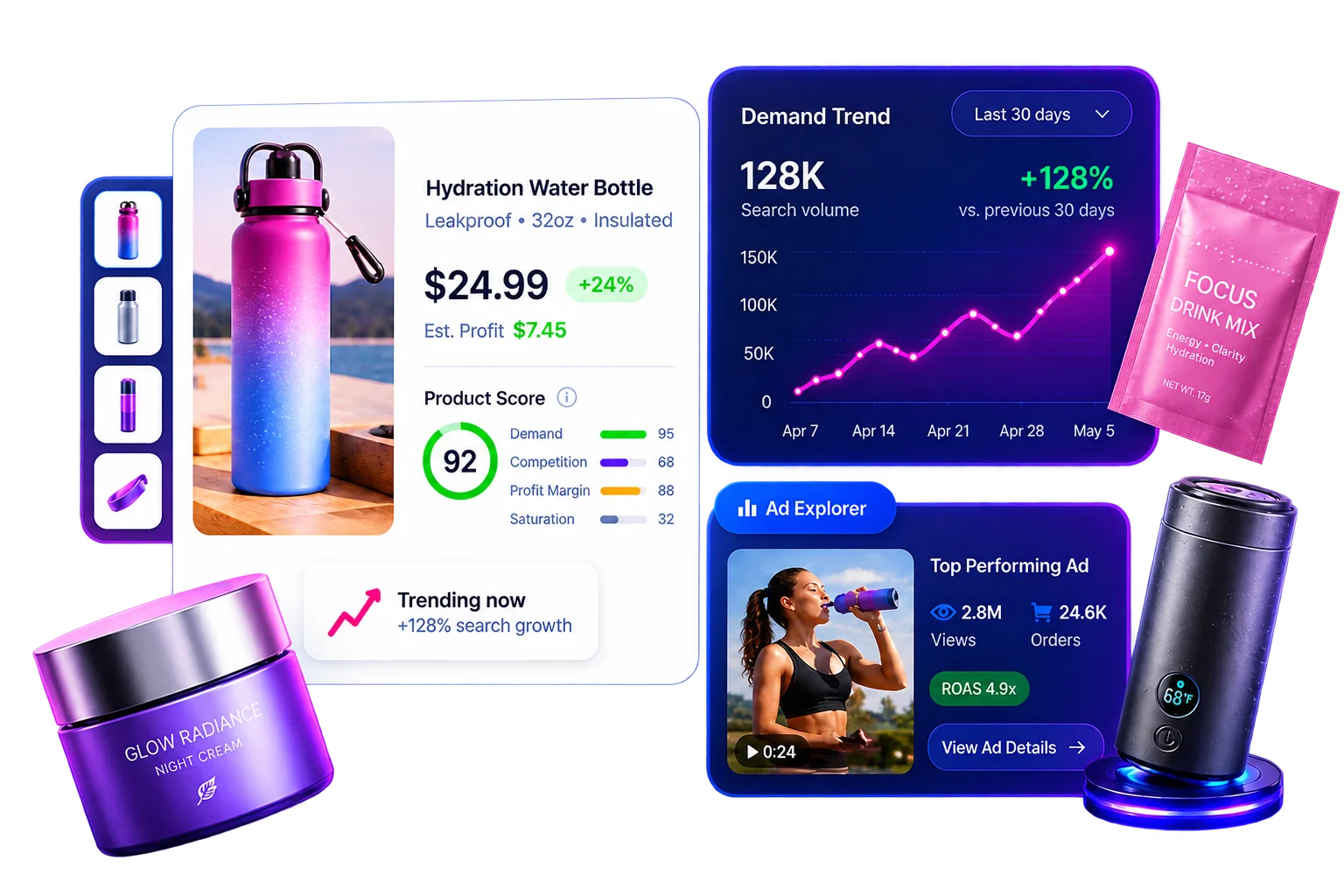
Reviewing dozens of product categories by hand to spot that gap is slow. Some sellers now speed this step up with AI research tools that scan reviews and listings across marketplaces and summarize which problems come up repeatedly and how saturated the existing solutions already are, which is close to what Dropmind's Winning Products is built to do on the consumer and advertising side, by combining product, ad, and trend signals into one research shortlist instead of a dozen open browser tabs. Separately, on the supplier and manufacturing side, Alibaba.com has built its own AI business agent, Accio Work, which includes automated market research and sourcing skills that can scan trending products on Alibaba.com and summarize the problems they solve. These are two different jobs: one helps you spot real demand from the buyer's side of the market, the other helps you see what's already being manufactured and marketed on the supplier side. Neither replaces reading real reviews yourself, but either can narrow a long list of possibilities down to a shortlist worth a closer look.
Step 2: Turn the problem into a specific product
Once you've locked in a problem, the search for a product needs to start from that problem outward, not from a product idea you already had in mind. If you found your problem through an existing product, it's tempting to jump straight to sourcing that exact item. Resist that. Search broadly for every product that claims to solve the same problem first, including ones you didn't already know existed, so you're choosing from the real field of options rather than the first thing you happened to notice.
For a laptop and keyboard spill-protection problem, that broader search might turn up several distinct solution types: clip-on cup holders, desk mats with raised edges, and silicone keyboard covers. Each solves the same underlying problem differently, and each has a different competitive picture. A plastic clip-on cup holder might already be a crowded, price-driven category. A desk mat with a cork base and a built-in reference print for common software shortcuts might reveal an underserved niche within a niche, since customers are specifically asking for features competitors haven't shipped yet.
Two questions matter most once you're comparing solution types against each other:
- Can you actually differentiate it? A product you can only sell by matching or beating a competitor's price is a product you'll likely lose money marketing. Look for a real angle: a feature nobody else offers, a build-quality improvement, a bundling opportunity, or an audience the existing options don't speak to directly.
- Does the margin support real testing? A rough industry rule of thumb some sourcing-focused sellers use is pricing a product at several times its landed unit cost, though the multiple that actually works varies a lot by category, price point, and how much you plan to spend on paid ads. For a full worked example that accounts for shipping, duties, payment processing, and a return reserve rather than just supplier cost and sale price, Dropmind's product research framework walks through a complete margin calculation you can adapt to your own numbers.
A two-in-one metal cup holder with an integrated hanger, for example, might land in a genuinely underserved spot: real demand, relatively few strong competitors building a premium version of it, and enough margin room to fund a real ad test. That combination, demand plus a gap plus workable economics, is what separates a product worth sourcing from one that only looked interesting for a few seconds on a trending list.
Step 3: Find a supplier who can actually make it
Before you contact a single supplier, get specific about your own plan. The perfect version of a product in your head might not exist at a price or minimum order quantity you can afford, so you need clear answers before you start comparing quotes, not after:
- Will you hold inventory yourself or fulfill through drop shipping?
- What features are genuinely must-have versus nice-to-have?
- Does the product need custom branding or packaging, or is a stock version acceptable for a first test?
- Who is the target customer, and what price point and margin does the product need to hit?
- How do you plan to brand and market it once it arrives?
With those answers in hand, search for multiple suppliers rather than settling on the first listing that matches. On a marketplace like Alibaba.com, that means comparing specifications, pricing at different order quantities, and minimum order quantities across several candidates for the same product, not just clicking into the first result. Manually opening dozens of browser tabs to do this is realistic but slow. AI sourcing tools, including Alibaba's own Accio Work agent, can pull together a comparison table of several suppliers automatically, complete with pricing, minimum order quantities, ratings, and direct links back to each supplier's page, which is genuinely useful for narrowing a long list down before you start reaching out.
If negotiating directly with an overseas manufacturer feels like more than you want to take on for a first product, that's a legitimate reason to consider a supplier platform built to handle more of that vetting for you. Services like CJdropshipping and Spocket pre-vet suppliers and, in Spocket's case, often work with US and EU-based suppliers directly, which can mean faster shipping and less back-and-forth than sourcing straight from a factory overseas. Dropmind's guide to vetting dropshipping suppliers compares more of these options if you want a fuller picture before deciding which route fits your first product.
Step 4: Reach out, compare quotes, and negotiate beyond price
Contact more than one supplier even if only one product listing genuinely caught your attention. Talking to several suppliers for the same or a similar product does two things: it gives you a real basis for comparison, and it gives you leverage, since a supplier who knows you're comparing quotes has more reason to compete for your order.
Price isn't the only thing worth negotiating. Depending on the supplier, you can often also discuss:
- Customization options and minimum order quantity for a customized version
- Lead time for both a sample and the full order
- Shipping method and cost, and who is responsible for import duties and tariffs on your end
- Payment terms, including deposit structure
- The level of customer support you can expect after the sale
On the shipping and duties point specifically, this matters more in 2026 than it did a few years ago. The United States ended duty-free treatment for low-value shipments under $800 for all countries effective August 29, 2025, and that change has held in place since. Low-value shipments from overseas suppliers now generally require formal customs handling and are subject to standard duty rates rather than the blanket exemption that used to apply, so it's worth confirming the actual applicable rate for your specific product and sourcing country before you finalize pricing, not after your first shipment arrives with a duty bill you didn't budget for.
Always ask whether a supplier provides samples, and pay for one even when it costs extra. A sample tells you two things at once: whether the actual product matches what you expected, and how a supplier handles a small, low-stakes order. A supplier who mishandles a sample is telling you something about how they're likely to handle your first real order too.
You can reach out to suppliers manually through a marketplace's built-in messaging, which is how sourcing has worked for years and remains a completely reasonable way to negotiate your first order. AI-assisted sourcing tools have started to offer a faster alternative: Alibaba's own Accio Work agent, for example, can draft an inquiry, send it to several suppliers at once through your connected account, and then continue the back-and-forth on your behalf, including negotiating price, asking about lead time, and requesting samples, while you review and approve what it sends. In one recent walkthrough of that kind of AI-assisted negotiation, a seller working through this exact process saw a supplier's quoted unit price drop from $6.99 to $4.99 at an order of only 100 units, a rate the supplier would normally reserve for orders of 500 units or more. That's a real result from one documented negotiation, not a guarantee you'll see the same discount. Supplier flexibility depends heavily on the product, the category, and how much room the supplier actually has in their own margin, but it illustrates why persistent, multi-supplier negotiation is worth the effort even on a first, relatively small order.
Once you have quotes back, compare them on total landed cost, not just unit price. A slightly higher per-unit price from a supplier with dramatically lower shipping can easily beat a cheaper unit price with expensive freight once you add both numbers together, and the same logic applies to sample cost, lead time, and each supplier's rating and reorder history.
Step 5: Place your order and treat it as a test
Once you've settled on a supplier, place your first order with the quantity, shipping method, and specifications you've agreed on. If you're sourcing through an AI-assisted tool, this step can be largely pre-filled from your negotiation, leaving you to review the details and confirm before it goes to the supplier. If you're sourcing manually, this is a straightforward order placed directly through the supplier's product page.
Keep your expectations honest here. Don't be surprised if your first product doesn't take off. Finding a genuinely winning product has a real methodology behind it, everything covered in this guide, but it also involves a fair amount of luck, timing, and trial and error. Sellers who eventually land on a strong product usually got there by testing several candidates, learning something concrete from each one, and adjusting, not by nailing their very first pick. Order a quantity you can afford to learn from either way, rather than betting your entire test budget on one product being the winner on the first try.
Common mistakes to avoid
- Starting with a product instead of a problem. A cool-looking product with no clear problem attached rarely converts as well as a plainer product that obviously solves something.
- Trusting a single signal. A high view count or one long-running ad is a data point, not proof. Check for agreement across multiple independent sources before committing a testing budget.
- Skipping the sample. A cheap product that arrives broken, mislabeled, or nothing like the listing photos will cost you far more in refunds and lost trust than the sample would have cost to catch it first.
- Negotiating with only one supplier. Without a second quote to compare against, you have no leverage and no way to know whether the terms you're getting are actually competitive.
- Ignoring the current duty rules. Pricing a product as though small international shipments still ship duty-free will overstate your real margin under the rules that have applied since August 2025.
- Giving up after one flop. A product that doesn't sell teaches you something specific about that product, price point, or audience. It says very little about whether you're cut out for this.
Frequently asked questions
Do I need AI tools to find a winning product?
No. Every step in this blueprint works with manual research: reading reviews yourself, messaging suppliers directly through a marketplace, and building your own comparison spreadsheet. AI research and sourcing tools mainly save time by summarizing information across more sources than you could reasonably check by hand, and by handling repetitive supplier back-and-forth automatically. They speed up the process; they don't replace the judgment calls in it.
How many suppliers should I contact before choosing one?
There's no fixed number, but reaching out to at least two or three suppliers for the same or a comparable product is enough to give you real leverage and a meaningful basis for comparison. Contacting only one supplier means you have no way to know whether their price, lead time, or terms are actually competitive.
What if my first product doesn't sell?
Treat it as information, not a verdict. A product that doesn't convert tells you something concrete, about the price point, the audience, the offer, or the competition, that makes your next test more informed. Most sellers who eventually find a product that works tested more than one candidate to get there.
Should I hold inventory or drop ship my first product?
That depends on your budget, risk tolerance, and how confident you are in the product before you commit to it. Drop shipping keeps upfront risk lower while you're still validating demand, while holding inventory can improve margin and shipping speed once you have real evidence the product sells. Decide this before you contact suppliers, since it changes what questions you need answered and what minimum order quantities are realistic for you.
How much should I expect to pay for a product sample?
Sample pricing varies widely by product and supplier, and it's often somewhat higher per unit than your eventual bulk price, since you're covering the supplier's setup cost for a single unit. Treat it as a small, worthwhile insurance cost against ordering a much larger batch of something that turns out to be poorly made, mislabeled, or different from what the listing showed.
The bottom line
The sellers who consistently find workable products aren't the ones with access to a secret list. They're the ones who start from a real problem, search broadly enough to see the actual field of solutions before picking one, compare more than one supplier instead of settling for the first quote, and treat their first order as a test rather than a final verdict. AI research and sourcing tools can make each of those steps faster, but they don't replace the sequence itself. Get the order of operations right, problem first, then product, then supplier, then negotiation, then a real order, and you'll have a repeatable process to run again on your second and third products, whether or not the first one wins.
If you want help with the research side of step one and two specifically, comparing demand, competition, and lifecycle signals across products, Dropmind's Winning Products is built to speed up exactly that part of the process, and Ads Explorer can show you how long a candidate's ads have actually been running before you treat that as evidence of real demand. Once you've sourced a product worth testing, setting up a store to sell it is the natural next step, and Shopify is the platform Dropmind's own tutorials are built around.