
Table of Contents (21 sections)
Every few months, a version of the same claim resurfaces in ecommerce and online business circles: form a US LLC, and you can legally stop paying tax altogether. It sounds like a loophole. It isn't. It's a real structure with real requirements, and most of the content explaining it skips the part that actually determines whether it works for you.
Here's the direct answer. A US LLC owned by a non-US resident can, under specific conditions, owe $0 in US federal income tax and $0 in US state income tax. That part is well established and verifiable directly from IRS guidance and state tax codes. What most explanations leave out is that the LLC is only one side of the equation. Your personal tax residency, not the LLC, decides what happens to that income once it reaches you. Get the LLC right and ignore your personal situation, and you can still end up owing significant tax, just not to the United States.
This guide walks through both halves: how the US side actually reaches 0%, and what has to be true about your personal situation for the full structure to work. It's written for the audience this actually applies to: dropshippers, ecommerce sellers, consultants, and other online entrepreneurs who live outside the United States and sell to customers who might be anywhere, including the US.
Disclosure: Some links in this article are affiliate links. We may earn a commission if you sign up or purchase through them, at no additional cost to you. This never changes which providers we mention or how we describe them.
The Two Layers of Tax That Determine Your Real Rate
Your effective tax rate on business income comes from two separate systems stacked on top of each other, and conflating them is the most common reason this structure gets misunderstood.
Corporate-level tax is what a business entity pays on its own profits, independent of who owns it. Personal-level tax is what you pay as an individual on income you receive, based on where you are a tax resident. A US LLC can legitimately eliminate the first layer for a non-US owner. It has no ability to touch the second, because that layer is governed entirely by the tax laws of the country where you personally live, not by anything the LLC does.
| Layer | What determines it | Can a US LLC structure eliminate it? |
|---|---|---|
| Corporate (the business) | Where the LLC is formed, whether it's foreign-owned, whether it does business inside the US | Yes, under the conditions below |
| Personal (you) | Your tax residency, i.e., where you live and how long you stay there | No. This depends entirely on your personal situation |
A genuine 0% outcome requires both layers to land at zero at the same time. That's a real possibility for some sellers, but it's a two-part condition, not a one-time LLC filing.
Why a US LLC Can Legally Owe $0 in US Tax
The mechanism behind this starts with what an LLC actually is by default. For the full mechanics of how an LLC works, including its liability protection and how it compares to other entity types, Dropmind's guide to what an LLC is covers that ground in depth. The short version: unless you elect otherwise, a US LLC is a pass-through entity, not a corporation. The LLC itself doesn't file and pay corporate income tax on its profits. Instead, all profit and loss flows through to the owner, who reports it on their own tax return. Legally, the LLC isn't a separate taxpayer; it's closer to a reporting vehicle for its owner's income.
For a US citizen or resident who owns an LLC, that pass-through profit is still fully taxable, just on their personal return instead of the company's. Two layers of US tax normally apply to that person: federal income tax, which is national, and state income tax, which depends on the state where the LLC operates.
Foreign ownership changes this. A single-member LLC that is wholly owned by a non-US person, and that has no US trade or business activity of its own (more on exactly what that means below), is generally not subject to US federal income tax on income that isn't effectively connected to a US trade or business. The federal layer can drop to $0.
That leaves the state layer, and this is where state selection matters. Every state sets its own rules for LLC-level income tax, and a handful of states, including Wyoming, Delaware, and New Mexico, don't impose a state income tax on LLC income at all. Combine a foreign owner with no federal tax obligation and a state with no LLC income tax, and the LLC itself can legally operate at $0 in US income tax on its business profits.
None of this is a gray-area interpretation. It follows directly from how pass-through taxation and nonresident-alien federal tax rules already work; the "strategy" is really just correctly applying rules that already exist, rather than exploiting a loophole.
The Three Conditions That Actually Make This Work
The $0 federal outcome depends on meeting all three of the following conditions. Miss one, and the structure doesn't apply the way it's usually described.
1. You are not a US citizen and not a US tax resident. This one is straightforward: the reduced-tax treatment applies to nonresident aliens, not to US persons who happen to route income through an LLC.
2. You have no physical presence in the US. No office, no warehouse, no employees, and no US real estate tied to the business. A registered agent address doesn't count as a physical presence; it exists specifically so a foreign-owned LLC can satisfy state requirements without the owner (or the business) needing an actual US location.
3. You are not "engaged in a US trade or business" (often shortened to ETBUS). This is the condition people misunderstand most often, so it's worth explaining carefully.
What "Engaged in a US Trade or Business" Actually Means
ETBUS is a real legal test under US tax law, defined in the Internal Revenue Code and its regulations, and it asks whether your business activity inside the US is considerable, continuous, and regular enough to amount to an active trade or business physically operating there. It is not about where your customers live.
Having US customers, accepting payments in USD, or running an ecommerce store that ships to US buyers does not, by itself, create ETBUS. What typically does create it:
- Employees or dependent agents inside the US performing work on the business's behalf
- A US office or fixed location where the business regularly operates
- A dependent agent inside the US who negotiates or concludes contracts on the company's behalf
So a consultant based in Portugal with clients in the US, or a dropshipper based in Indonesia selling to buyers worldwide including the US, generally is not engaged in a US trade or business, as long as the actual work and decision-making happen outside the US and nothing in the business creates a US-based presence. This is exactly the profile many international ecommerce sellers already have: sourcing, fulfillment through non-US suppliers, and business operations run from wherever the owner lives, with US customers simply being one part of a global customer base.
One structure worth flagging here: if a US-based entity or agent is used to receive and process customer payments on the business's behalf inside the US, that processing activity can itself support an ETBUS finding for the foreign owner, independent of where the profit ultimately lands. If your setup involves any US-based intermediary handling transactions, that's a detail worth having a tax professional confirm before assuming ETBUS doesn't apply.
Choosing a State to Form In
Once the three conditions are met, the next practical decision is which state to form the LLC in. Three states come up consistently for non-US founders because none of them charge state income tax on LLC income: Wyoming, Delaware, and New Mexico.
| State | Annual state fee | What it's known for |
|---|---|---|
| Wyoming | $60 minimum annual report license tax (or a small percentage of in-state assets, whichever is greater) | Low ongoing cost, strong owner privacy, no state income tax |
| Delaware | $400 flat annual LLC tax, due June 1, no separate annual report required | Established legal system, common for startups planning to raise investment |
| New Mexico | No annual report requirement at all | Strongest privacy profile of the three; lowest ongoing paperwork |
Wyoming is the most commonly recommended option for international founders who don't have a specific reason to choose otherwise, mainly because of the combination of a low, flat annual cost, no state income tax, and owner information that isn't published in a public database the way it is in many other states. Delaware's reputation is strongest for businesses planning to raise outside investment or that need Delaware's well-developed corporate case law; that advantage matters less for a solo online seller who isn't raising capital. New Mexico trades a slightly less established formation ecosystem for the lightest ongoing compliance burden of the three.
There's no single correct answer here. All three eliminate the state income tax layer; the difference is mostly cost, privacy, and how much annual paperwork you're willing to maintain.
What You Actually Need to Set It Up
This article focuses on why and where, not the mechanical filing steps; Dropmind's complete LLC registration checklist walks through the actual formation paperwork step by step. Beyond the state filing itself, three things make the structure functional.
A registered agent. Every US LLC is legally required to have a registered agent: a person or company with a physical address in the state of formation who accepts legal and government mail on the LLC's behalf. For a non-US founder without a US address, this isn't optional paperwork; it's the only practical way to satisfy the requirement. Registered agent services typically bundle formation filing, mail forwarding, and compliance-deadline tracking into one annual fee. Northwest Registered Agent is one commonly used option that specifically supports non-US founders through the formation and registered-agent process.
An EIN. An Employer Identification Number is the LLC's federal tax ID, required to open a business bank account and to file the compliance forms covered below. US applicants can get one instantly through the IRS's free online EIN application, but that tool requires a Social Security Number or ITIN as the "responsible party." Founders without either have to apply by fax or the IRS's international phone line using Form SS-4, which takes longer but doesn't require a US SSN. A registered agent service can typically handle this application on your behalf. If you also need a personal US tax ID (an ITIN, which is a different number from the EIN and solves a different problem), you can apply directly through the IRS, or use a service like TheITIN, which is a private application-assistance provider, not the IRS itself, and doesn't guarantee approval.
A business bank account. Several banking platforms let non-US founders open a US business account fully remotely, without a US Social Security Number or an in-person branch visit. Airwallex and Mercury are both commonly used for this, along with Relay; Wise Business is a multi-currency alternative worth comparing if you're already collecting payments in more than one currency. None of these carry the same legal status as a traditional chartered bank, so it's worth confirming current account terms directly with the provider before relying on one for anything beyond routine payment collection.
Your Personal Tax Residency Still Determines the Real Outcome
This is the part that gets left out of most short explanations, and it's the difference between a structure that actually reaches 0% and one that just moves where you owe tax.
Because the LLC is a pass-through entity, its profit flows straight through to you personally, and you are taxed on it wherever you are a personal tax resident. If you live in Germany full time and run a US LLC with $0 in US tax, that income still generally has to be reported and taxed under German personal income tax law, because Germany is where you actually live. Forming the LLC didn't touch that obligation at all; it only removed the US layer.
Two general approaches address this second layer, and they come with meaningfully different levels of practical risk.
Approach 1: Not Being a Tax Resident Anywhere
Some entrepreneurs structure their lives so they never establish tax residency in any single country: deregistering from their home country, closing local accounts, and then splitting time across multiple countries without staying long enough in any one of them to trigger that country's residency rules (which commonly hinge on spending more than 183 days a year there, though the exact threshold and criteria vary by country).
If genuinely no country has a claim to tax you as a resident, the personal layer can also land at 0%. In practice, this is harder to execute cleanly than it sounds. It requires real, verifiable separation from your previous home country (not just spending less time there while keeping a lease, a bank account, or family ties that a tax authority could point to), and it can create friction with banks and payment processors that expect a stable address on file. This approach works only when it's deliberate and thoroughly documented, not as a side effect of frequent travel.
Approach 2: Becoming a Resident of a Low-Tax or Territorial-Tax Country
A more common and generally more stable approach is establishing tax residency in a country with no personal income tax, or one that only taxes income sourced from inside that country (a territorial system).
The United Arab Emirates has no personal income tax on salary, business income, or investment income for individuals; profit that reaches you personally through the LLC is not taxed there. (The UAE does apply a 9% corporate tax on taxable income above AED 375,000 for businesses operating inside the UAE, but that's a separate rule from personal income tax and generally doesn't apply to a foreign LLC's profit received as personal income.) Paraguay uses a territorial tax system, meaning it generally taxes only income earned from Paraguay-based sources; foreign-sourced income, including profit from a US LLC serving customers outside Paraguay, generally falls outside what Paraguay taxes.
Other countries sometimes mentioned in this context, including Malaysia and Thailand, are more complicated and change more often than people expect. Thailand tightened its rules on foreign-sourced income brought into the country starting in 2024, and further changes have been proposed since; Malaysia's exemption for certain foreign-sourced income for individuals is time-limited and has an expiration date that gets extended periodically rather than being a permanent feature. Anyone considering either country for this purpose should verify the current rule directly before relying on it, since what was true a year ago may not be true now.
Under this approach, the LLC still pays $0 in US tax, and your personal tax bill depends entirely on the country where you actually establish residency, which is a more concrete, documentable position than the no-residency approach above.
Staying Compliant: What You Still Have to File
A $0 tax bill doesn't mean $0 paperwork. Two filings keep a foreign-owned LLC in good standing, and skipping either one carries real consequences.
Form 5472, attached to a pro forma Form 1120. A foreign-owned single-member LLC has to file this informational return with the IRS every year, even though it owes no US tax. It doesn't report a tax bill; it reports the LLC's transactions with its foreign owner and other related parties, mailed to a dedicated IRS address rather than filed electronically. According to the IRS's own instructions for Form 5472, the penalty for failing to file Form 5472 or failing to maintain the required records is $25,000, with an additional $25,000 if the failure continues more than 90 days after the IRS notifies the business. This is not a minor filing to skip.
The state's annual report. Wyoming's is a flat $60 minimum per year (or a small percentage of assets located in the state, if that's greater). Delaware charges a flat $400 annual LLC tax instead of a separate report. New Mexico currently requires neither. A registered agent service can typically handle this filing as part of its annual fee.
Beyond these two, ongoing compliance is genuinely light for a foreign-owned LLC with no US operations, which is a real part of why this structure is popular. Light doesn't mean optional, and the $25,000 Form 5472 penalty specifically is high enough that it's worth building a yearly reminder around, or paying a registered agent or accountant to track it for you.
The Exception: Income That's Actually Sourced From the US
One category of income falls outside this structure regardless of the LLC setup: US-sourced income that counts as FDAP (fixed, determinable, annual, or periodical) under US tax law. Common examples include YouTube AdSense revenue attributed to US viewers, Amazon affiliate or royalty payments, and dividends from US stocks.
This type of income is generally subject to a default 30% US withholding tax for nonresident aliens, unless a tax treaty between your country of residence and the US reduces that rate. Importantly, this withholding applies whether or not you have a US LLC at all; it's a feature of how the US taxes that specific income category at the source, not something the LLC structure creates or can avoid. For most ecommerce sellers whose revenue comes from product sales and services rather than US-source royalties or dividends, this exception rarely applies in a meaningful way, but it's worth knowing about if any part of your income falls into one of these categories.
Who This Actually Fits
This structure tends to work cleanly for consultants, coaching businesses, agencies, and ecommerce or dropshipping sellers who perform their work outside the US, serve an international customer base that may include US buyers, and don't maintain any US-based operations, staff, or inventory. If you're building the dropshipping side of this from scratch, Dropmind's guide to legally starting a dropshipping business covers the broader registration and tax-registration checklist for online sellers specifically.
It gets more complicated for sellers using US-based fulfillment infrastructure, such as inventory held in a US warehouse through a fulfillment network. Holding inventory in the US and having it shipped by a US-based fulfillment operation can raise separate questions about physical presence and dependent-agent activity that go beyond simply having US customers, and it's a scenario worth reviewing with a tax professional rather than assuming the standard 0% framework applies unchanged.
Common Mistakes
- Assuming the LLC alone gets you to 0% tax, without addressing personal tax residency at all
- Treating "no country can tax me" as automatic just because you travel frequently, without actually deregistering from a previous tax residency or documenting the separation
- Confusing ETBUS with simply having US customers or accepting USD payments
- Skipping Form 5472 because "the LLC doesn't owe any tax anyway"
- Assuming Thailand, Malaysia, or similar territorial-adjacent countries work the same way this year as they did last year, without checking current rules
- Using a US-based payment processor or agent in a way that creates a US presence without realizing it
Frequently Asked Questions
Is a foreign-owned US LLC actually legal?
Yes. Forming a US LLC as a non-US resident and operating it under the conditions described above is a legitimate use of existing US tax rules, not a loophole or gray-area workaround. The rules that make the $0 federal outcome possible (pass-through taxation and the nonresident-alien federal tax treatment) already exist independently of this specific use case.
Do I still need to file US taxes if my LLC owes $0?
Yes. A foreign-owned single-member LLC still has to file Form 5472 with a pro forma Form 1120 every year, even with no tax owed. This is an information return, not a tax bill, but the penalty for skipping it is $25,000.
Which state is best for a non-US resident forming an LLC?
Wyoming, Delaware, and New Mexico all avoid state income tax on LLC profit. Wyoming is the most commonly chosen for its low flat annual fee and strong privacy; Delaware suits businesses planning to raise investment; New Mexico has the lightest ongoing paperwork of the three.
Does having US customers make my LLC subject to US tax?
Not by itself. Having US customers or accepting USD payments doesn't create "engaged in a US trade or business" status on its own. What typically does is having US employees, a US office, or a dependent agent negotiating contracts inside the US.
Can I really pay 0% personal tax too?
Only if your personal tax residency situation supports it, either by establishing residency in a country with no personal income tax or a territorial system, or by genuinely not holding tax residency anywhere. The LLC itself has no effect on this layer; it depends entirely on where you live and how that country taxes you.
What happens if I have US-sourced income like AdSense or US stock dividends?
That income is typically subject to a 30% US withholding tax for nonresident aliens, regardless of whether you use a US LLC. It's a separate rule from the LLC's own tax treatment.
This information is provided for general educational purposes and may not apply to every business or jurisdiction. Consider consulting a qualified legal, tax, or financial professional for advice specific to your situation.
Where This Leaves You
A US LLC can legitimately reach $0 in US federal and state tax for a non-US resident who meets all three conditions: not a US citizen or resident, no physical US presence, and no US trade or business. Getting there requires the right state, a registered agent, an EIN, and ongoing compliance, most importantly Form 5472. None of that is the hard part.
The part worth spending real time on is your own personal tax residency, since that's what actually determines your total effective rate, not the LLC. Talk to a qualified tax professional who understands both US nonresident tax rules and the tax law of wherever you actually live before finalizing this structure, since the personal side is where the real complexity, and the real risk of getting it wrong, tends to live.
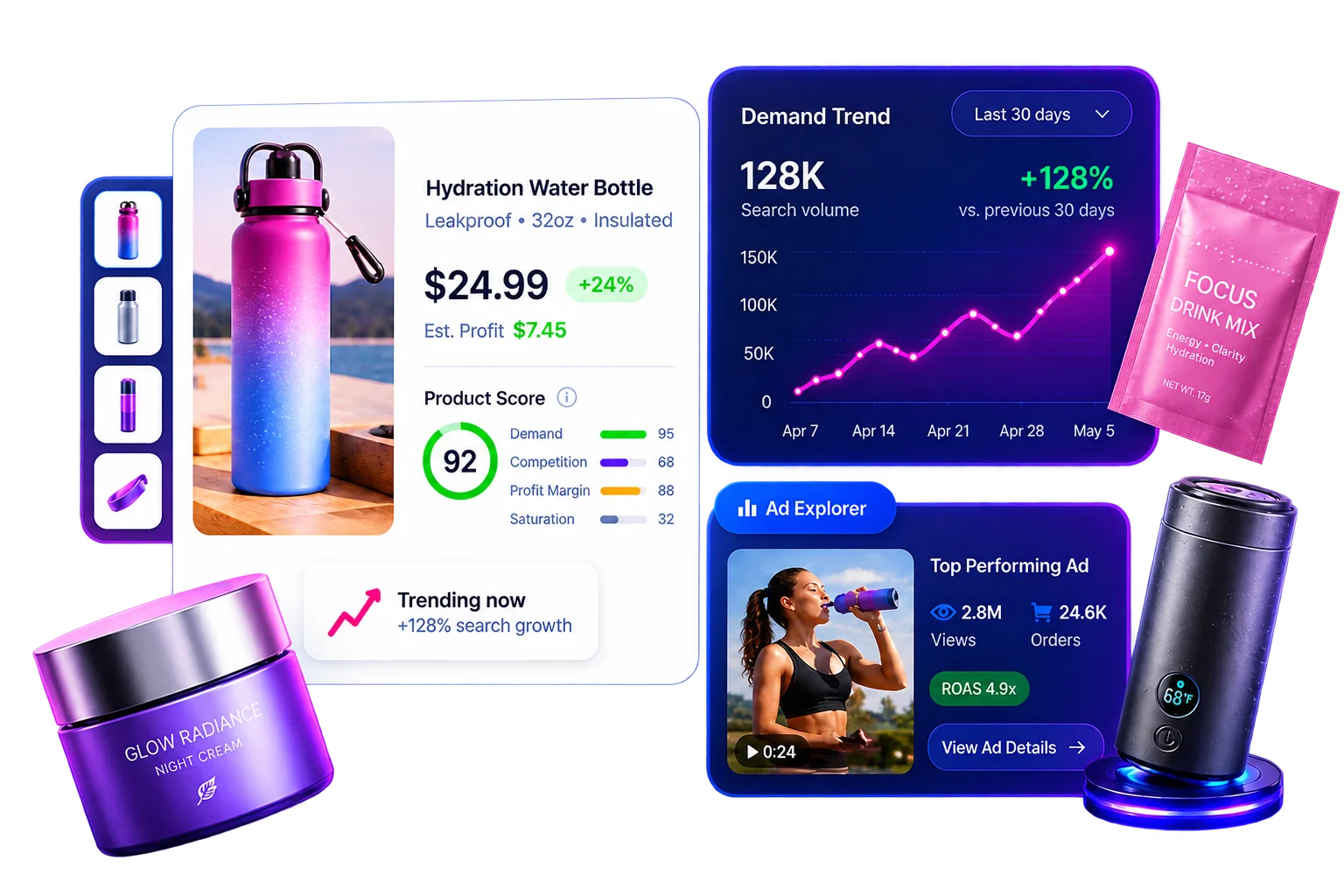
Once the legal and banking side of an international ecommerce business is in place, the next real decision is what to sell into those markets. Dropmind's research-based framework for finding winning dropshipping products walks through evaluating product opportunities with real signals instead of guesswork, and tools like Winning Products and Ads Explorer help validate demand before you commit ad spend to a new market.